
ShareDrop Sends Files Device to Device Again: A Quick Guide
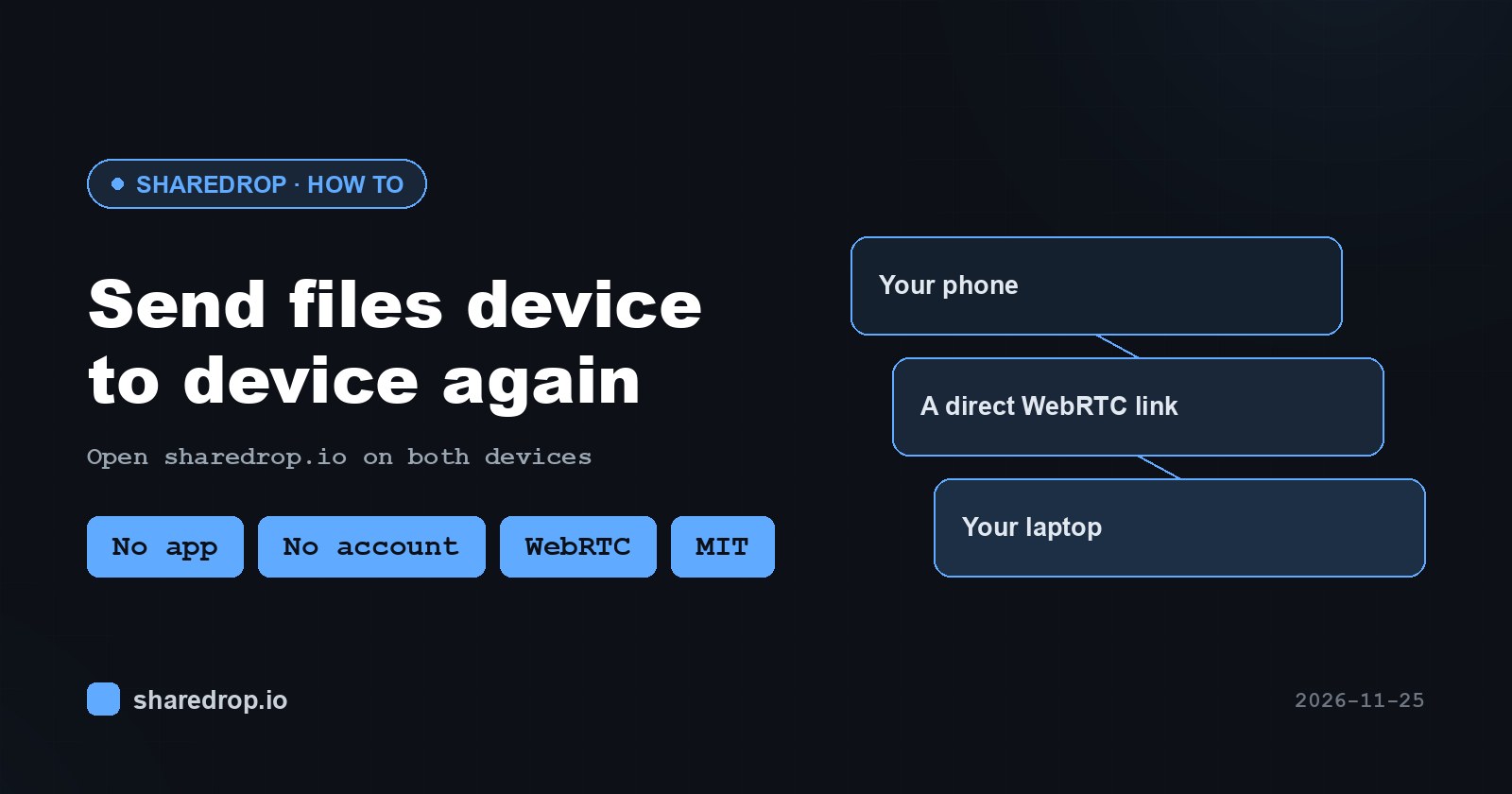
ShareDrop moves files from one browser straight to another again. You open the page on both devices, choose the receiver, and it accepts. Below are the exact steps for the usual cases and the few things that tend to get in the way.
Phone and laptop on the same Wi-Fi
- Open sharedrop.io on the laptop and on the phone.
- Wait a second: each device appears on the other one under a random name.
- On the sending device, tap or click the other device and choose the files. On a computer you can also drag files onto it.
- On the receiving device, check the sender’s name and the file count, then press Accept.
- Press Save when the transfer finishes.
Keep the page open and the screen awake until it completes. Mobile browsers pause pages in the background, which stops a transfer midway.
Two devices on different networks
Laptop on office Wi-Fi, phone on mobile data: they will not see each other on their own. Link them once:
- On one device press “Connect with a code”. It shows a QR code and six digits that refresh every 30 seconds.
- Scan the QR code with the other device’s camera, or open sharedrop.io there and type the digits.
- Confirm with “Link” on the first device.
From then on the two devices find each other on any network. A pairing expires after 30 days without the devices meeting. Link only devices that are yours or belong to someone sitting next to you.
When the receiver is not online
Direct transfer needs both ends present. If the other person is elsewhere or offline, use “Share a Link”. That option uploads the files to LimeWire and gives you a link that works on any device for 3 days on a free account. It is a separate path from the direct one, and the page labels it as such.
Privacy in plain terms
- Files sent directly are not stored by us. They go through an encrypted WebRTC channel from browser to browser.
- A pairing server helps the two browsers find each other. It handles names and connection details, not file contents.
- Like every WebRTC connection, the two devices see each other’s network address during the transfer.
- Nothing arrives until the receiver presses Accept.
Open source
The code that runs on sharedrop.io is published at github.com/LimeWireOfficial/sharedrop.io, refreshed automatically each time the site is deployed. ShareDrop was created by Szymon Nowak and released under the MIT license; that notice is kept in the repository. The repository does not include the pairing server, so a self-hosted copy needs its own.
Troubleshooting
- Devices do not appear. Turn off any VPN on both devices, or use the code.
- The connection drops. Keep both screens on and the page in front.
- A big file fails on a phone. Phones run out of memory sooner than computers; send big files as a link.